
Didn't You Know?
A letter from Mauthausen and and what God asks of every generation

Friends,
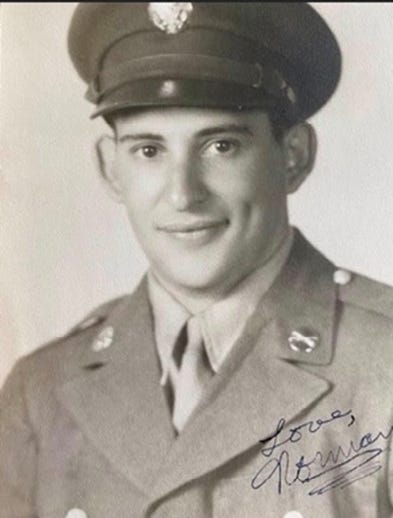
This essay, for Yom Ha-Shoah draws on the letters my grandfather, Norman Winiker, wrote to his family while stationed in the concentration camp of Mauthausen in June 1945. We only discovered them after his death, and it has become our family custom to read them every year on Yom Ha-Shoah. My oldest son, Nahum, carries his name.
Also: I’m excited to announce that Smol Emuni will be hosting an online conversation about my new book, Zionism in Crisis: Jewish Power and Moral Responsibility After October 7, with Rabbi Chaim Seidler-Feller on Wednesday, April 22nd from 12:30 to 1:30 PM EST. The event will be on Zoom and you can RSVP here. And if you know people that might be interested in the book, please let them know about it.
Kol tuv,
Rabbi Zach Truboff
Didn’t You Know?
My grandfather was twenty years old when he wrote home from Mauthausen. It was June 1945. He was a Jewish soldier from an immigrant family, serving guard duty at the camp which had been liberated not long before he had arrived. The shifts were four hours on, twelve hours off, and between them, he wrote long letters home. One letter, dated Saturday and Sunday, June 16th and 17th, 1945 is the one I keep coming back to.
He wanted his family to see what he saw. The whole letter is an exercise in seeing. He meticulously, almost compulsively, described what he had discovered there, as if the act of writing could carry the weight of what he’d witnessed across the ocean and into his parents’ living room in Brooklyn.
He described the gas chamber, “where people were packed in tightly, told they were to be given a shower and given soap only to be dead five minutes later by lethal gas sprayed from the seemingly innocent shower outlets.” The crematorium was “4 ovens capable of burning 8 persons at a time stacked one body upon another with a tray underneath the grate to catch the human fat as it melted.” The hooks “where people were hung beneath their chin while waiting their turn to be shot against a nearby wall.” And the quarry with its 186 steps of death, where prisoners were given a sixty-pound block of stone and made to ascend without stopping. “If the person knew he couldn’t do it, he just dropped the rock and kept walking up the steps. At the top an SS man would either just shoot him on the spot or playfully give him a shove off the steep cliff alongside the steps.” My grandfather’s post was just atop that cliff. “Let me tell you,” he wrote, “in the middle of the night I can just picture what went on and boy, I shudder.”
He described the survivors. “Gaunt women with pipestem arms and legs. You look at them and wonder how they manage to still stay alive. And then some don’t.” And he described the dead — “their forms underneath the sheet is negligible and they scarcely make a bulge in the sheets, just skin and bones.” He described the mass graves outside the main gate, “layers of bodies (only God knows how many) and then dirt and then bodies, etc. till the land was raised about fifty to one hundred feet.”
He saw all of this and he wrote it down. He notes how one of the officers who lectured his unit had told them: “when after this war or now, you see atrocity movies or newsreels of what occurred in these death camps or read stories written by those who’ve lived thru this terror, believe them because by God every thing they say is real and has happened.”
But the letter doesn’t end with the camp.
---
“When I came back from Paris,” my grandfather wrote, “and found the boys in the new billets, I also found that they were having people [survivors] come down from the camp and clean up our house. Well, I didn’t pay any attention to them until three days ago.”
He went down to the basement, only to see a woman ironing uniforms. “She looked at me, I looked at her and finally she said, in German of course, ‘I think you’re Jewish.’”
Her name was Celia. She was thirty years old, from Cracow. Her father had died in World War I. Her stepfather treated her badly and wouldn’t let her go to school. So, she taught herself tailoring and married an uncle from Limburg. They were in love. But then, in September 1939, after Germany invaded Poland, her husband was sent to a camp. Her infant daughter contracted tuberculosis and died. And then she was sent to the camps herself and never heard from her husband again. All her relatives had perished or disappeared.
My grandfather spent hours and hours talking to her. His Yiddish was rusty; hers was Galitzianer. “But we make out O.K,” he told his parents.
And then this:
“How she ever survived through all the bloodshed that surrounded her, she herself doesn’t know. Just the hand of God. She has told me many of the things she’s seen happen in these camps down to the last detail and I just can’t bring myself to write them down. She’d describe an incident and then she’d ask me, “Didn’t you Jews in America hear about these things?” I told her yes but I just couldn’t answer when she came back with “why didn’t you do something at the beginning?”
I have read this letter a hundred times since we discovered it after he died. And every time, it is these two questions that stop me.
---
“Didn’t you Americans hear about these things?” Yes. Of course, they heard. The knowledge of what was happening to the Jews of Europe during the Holocaust was known. It may have been distant, abstract, incomplete — but it was there. American Jews knew.
“Why didn’t you do something at the beginning?”
Silence. My grandfather — voluble, generous, a young man who would do his best to give this brokenhearted woman a lecture in broken Yiddish on the greatness of life — could not answer this question. And he said so. He told his family, “I couldn’t answer.”
The reality of Mauthausen entered his world when he saw it with his own eyes, all its horrors—the ovens, the quarry, and the bodies. But Celia’s questions were different. The horror could be witnessed and recorded. Her questions forced him to confront something else entirely. I think they broke something open inside of him. Because ‘why didn’t you do something when your own people were being slaughtered’ has no answer that puts the world back together.
Though he couldn’t answer her questions, he refused to look away from the person in front of him. When she mentioned that she had “even thought of suicide,” he acknowledged that “I couldn’t blame her in some ways, but I gave her one of the longest lectures I’ve ever given in Yiddish on the greatness of life and the presence of everlasting hope. I’m telling you I put my heart into it.” He gave her cocoa, coffee, cigarettes, and lifesavers. He started teaching her English as they continued to meet, and wrote home begging his parents to find her uncle in New York:
“Hersh, (probably Harry), Fliesser-Baar. Now, I’m guessing at the English spelling of the name. You could probably get any number of American names out of it but please try and see what you can do about locating him. I know it’s a million to one chance but she’s such a nice kid.”
---
Ayeka. Where are you?
It’s God’s first question to Adam, in the garden, after breaking the one commandment he had been given. Of course, God knows where Adam is. No human being can hide themselves from God, no matter how hard they try. Rather, the question is asked by God to make Adam account for himself. To make him stand in the presence of what he has done.
God asks a similar question in the very next chapter.
Ei Hevel achicha. Where is your brother?
God knows Abel is dead. The question is to force Cain to face it. To make it impossible for him to pretend that the blood of his brother, which he has just spilled, isn’t crying out from the ground.
Rashi teaches that God’s questions to Adam and Cain are not meant to be a form of condemnation or accusation. Instead, God asks them to enter into conversation — l’hikanes imo b’dvarim — with both of them, so that perhaps it will provoke them to take responsibility for what they have done.
Celia’s questions have the same structure. She does not know whether they heard — she has been in the camps for years, cut off from the world. She is genuinely asking. And when my grandfather tells her yes, the second question becomes unbearable. You knew, and you did nothing. She is asking him to account for that— and he cannot. Just as God calls Adam and Cain to answer for what they knew and what they did, Celia is calling my grandfather to answer for what he knew and what he failed to do.
But here is where Yom HaShoah makes its hardest demand on us. We often think of God as the one who brings justice. The one who shatters the chains placed on slaves and brings even the great Pharaoh of Egypt to his knees. Yom HaShoah, however, forces us to confront the fact that sometimes the cry goes up to God, and there is no answer. God does not always act. The cries of six million testify to that silence. But God’s questions remain. They persist, carried from one generation to the next, as long as human beings are willing to ask them. Where are you? Where is your brother? Celia in that basement is asking God’s questions. Not because she is God. Because God asked them first, and now they belong to all of us.
And Cain’s answer — ha’shomer achi anochi, am I my brother’s keeper? — that is the answer of every generation that hears the question and turns away.
---
We only discovered these letters after my grandfather died. But years before that, when I was still in college, I had sat with him and asked about his experiences in the war. I knew he had fought in Germany and had been stationed at Mauthausen, but little more than that. He had never spoken about the survivors he met there, certainly not by name. In our conversation, he didn’t mention Celia. He didn’t mention her questions. Instead, he spoke more generally about the camps, the survivors, and what he’d seen. He said that when he closes his eyes, he can still see the gaunt image of the survivors in their black and white stripes. Even now, he said, seeing that kind of image makes him shiver.
He explained that what he saw taught him that if it could happen there, it could happen anywhere, and that when he returned to America, he carried that knowledge and it led him to see the injustices all around him. It made him socially and politically conscious in a way that he had never been before, and he would spend the rest of his life committed to not just seeing the world, but acting to change it.
As a rabbi, I would later use this example to explain how stories, particularly the story of the Exodus, can be passed down from one generation to the next. That in hearing the telling from others, we see ourselves within it, and that if we retell it ourselves, it is as if we were there. B’chol dor v’dor. In every generation. And that if I closed my eyes, I could see those Holocaust survivors as well, the ones my grandfather saw.
When I first heard my grandfather’s story, I heard powerful but familiar lessons about the Holocaust. There is evil in the world and we must be vigilant. If it happened there, it could happen here. These lessons are important, but can be learned by anyone, even those who had never spent a night in Mauthausen gazing off into the ravine where hundreds of Jews had fallen to their deaths. What I only understood after reading his letter was the image he saw when he closed his eyes — Celia, her questions, and the crack they made in his world that never closed.
Though he never spoke about her to any of us, the moment I finished reading the letter, I knew he never forgot her. Not for a single day. Why? Because the woman he married — my grandmother, the woman he called by name every day for the rest of his life — was also named Celia.
---
When I close my eyes, I can see them too. I can see her. I can hear her questions.
The Alter Rebbe of Lubavitch teaches that the question of Ayeka — where are you? — is addressed to every person in every generation, Jew and non-Jew alike. We like to think that God’s questions are directed only at those we hold responsible for the evils around us — that someday they will wake up, that there is no place they can hide from accountability. But that kind of thinking is just Cain’s answer of denying one’s own responsibility, just dressed up as righteousness.
God’s questions are asked of all of us, at every moment of every day. Not because all bear the same guilt, but because no one stands wholly outside the worlds they inhabit. Each of us knows of evil, has seen it within our own lives, and on some level knows that they too are part of it. We live within systems shaped by injustice, benefit from arrangements whose costs are borne by others, and learn to avert our eyes from suffering that does not fall directly upon us. That does not erase the difference between perpetrator, victim, and witness. But it does mean none of us can pretend innocence simply because we did not wield the knife ourselves. Like Adam, we cannot hide from God, and like Cain, we cannot deny that our actions or inactions have brought harm.
It is God’s questions as spoken to my grandfather in the depths of Mauthausen that have animated everything I write about Zionism and Israel, especially since October 7, about what we are doing and what we are failing to see.
And it is why I am drawn, on this Yom HaShoah, to a speech given ten years ago by Yair Golan, then the IDF Deputy Chief of Staff — a man whose own father had fled Nazi Germany for Palestine in 1935. On Yom ha-Shoah 2016, standing at the Massuah Institute for Holocaust Studies, Golan said:
“The Holocaust, in my opinion, must lead us to a deep reflection on the nature of the human, even when that human is ourselves. It must lead us to a deep reflection on the responsibilities of leadership, and on the quality of society. It must lead us to think thoroughly about how we — here and now — treat the foreigner, the widow and the orphan, and those similar to them.”
That was the call to account for ourselves. And then Golan named what he saw:
“If there is something that scares us about the memory of the Holocaust, it is identifying nauseating processes that occurred in Europe in general and Germany in particular, 70, 80 and 90 years ago, and finding evidence of their presence here among us, today, in 2016. For there is nothing easier than hating the alien. There is nothing easier than to stir fears and intimidate. There is nothing easier than to behave like an animal and to act sanctimoniously.”
In that moment, I now realize, Yair Golan was asking God’s questions, just as Celia had asked my grandfather decades before: Don’t you see what is happening? Don’t you know we must do something? The response to Golan, of course, was harsh, extraordinarily harsh. He was forced to retract his words and practically retreat from public life. But the reason he could say what he did, and the reason we must be willing to listen, is not because he was a prophet, not in the traditional sense. It is because the Torah teaches that the cries of the oppressed are always heard — by God, and then by those willing to carry God’s questions forward — even as our world is built to make us think we do not have to hear them. We know there is evil all around us, and each one of us knows we are implicated in it. But we live as if that is not the case. We hide, like Adam did. We deflect, as Cain did.
Those who responded harshly to Yair Golan’s speech said it cheapened the Holocaust. They reduced it to something he never said. They pushed away the questions it raised, and they ran from it. Which is what you do when the question is about you.
The speech effectively ended Golan’s military career. But the processes he named then did not stop.
---
It is Yom HaShoah, 2026. Eighty-one years since my grandfather sat in a basement in Mauthausen and a woman named Celia asked him two questions he couldn’t answer.
They are still unanswered. Not because no one has tried. But because God’s questions don’t get answered. They get carried. From Celia to my grandfather. From my grandfather to me. Writing is how I carry them forward.
Didn’t you know?
Why didn’t you do something?
The only honest answer to these questions is the one my grandfather gave. Not to hide from them or deny them, but silence. To sit with them, no matter how painful it may be. To let them into your world, as my grandfather did, and allow them to change the way you see it. Because once you have seen what you have spent your life trying not to see, you can’t forget it. It changes you, as it changed my grandfather. And then, like my grandfather, you start asking those questions and begin to act. Not because you have the answer. But because someone is standing in front of you, and you finally hear their cries.
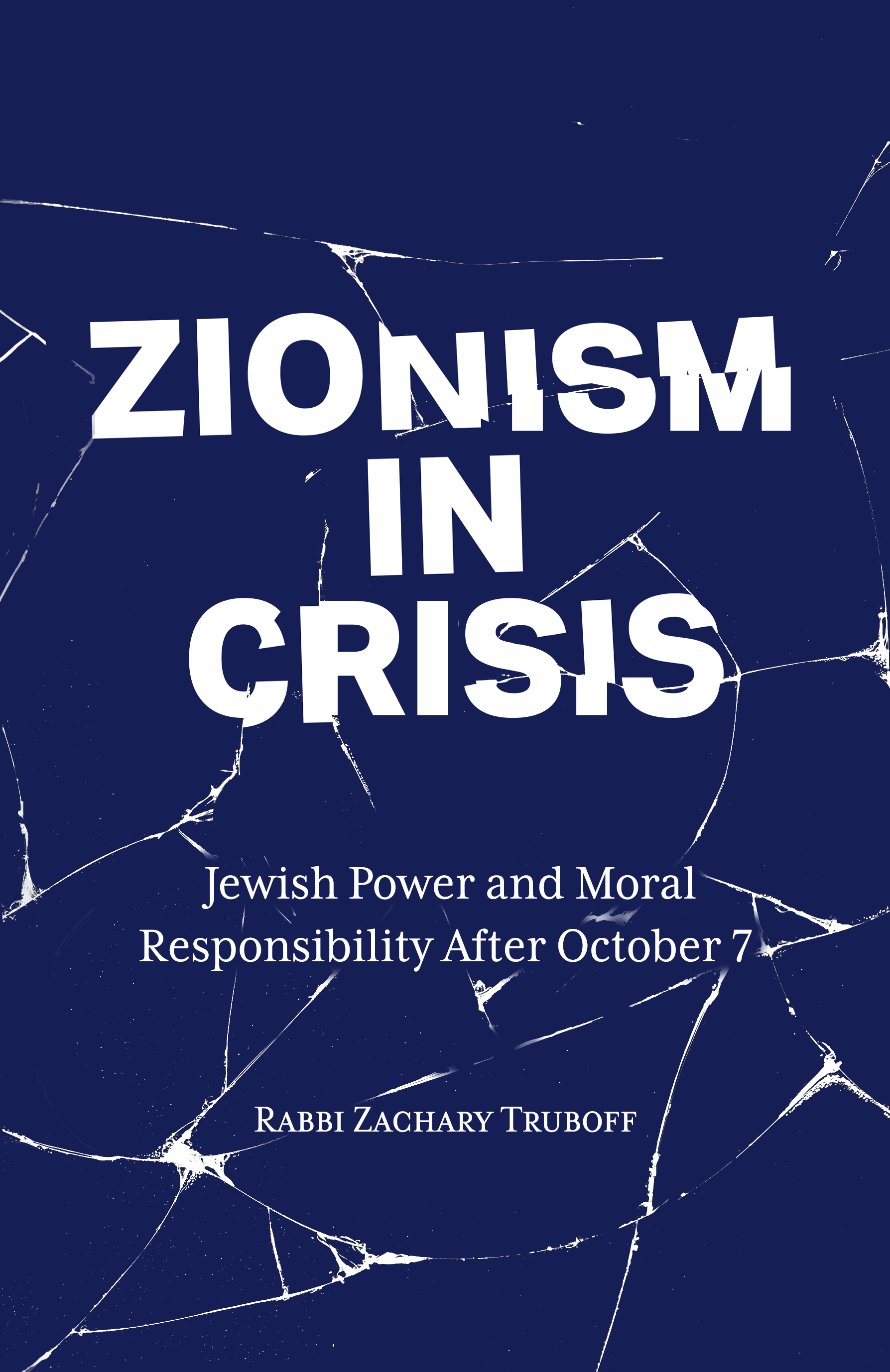
In the aftermath of October 7 and the war that followed, Zionism faces a moment of rupture. The trauma of the attacks, the brutality of the war, and the reemergence of antisemitism have made sustained moral and political reflection increasingly difficult. Even under these conditions, the failure to reckon honestly with Jewish power now threatens Zionism from within.
Drawing on Jewish theology, Zionist history, and contemporary political thought, Zionism in Crisis brings together essays that challenge sweeping defenses of Israel’s actions and total condemnations of Zionism. At its core, it is a call for teshuvah — a call to question whether the path we are on is the right one, to name what has gone wrong, and to change course before it is too late.
You can order the book here:
If you know someone for whom this book might be appropriate — someone willing to wrestle honestly with what Zionism has become and what it must yet become — I’d be grateful if you’d share this with them.